Walter Writes AI in the Philippines
Walter Writes AI is available to users in the Philippines and works identically to other regions. There are no region-specific restrictions on the tool or its capabilities. This page covers how Walter Writes AI performs in the Philippines academic context specifically.
The Philippines is one of the largest markets for Walter Writes AI globally. Filipino students are among the most active users of AI writing tools, partly because English is a medium of instruction at most universities and partly because Philippine higher education has seen rapid adoption of both AI tools and AI detection in recent years.
Major Philippine universities including UP, Ateneo, DLSU, and UST have updated their academic integrity policies to address AI writing tools. Many now use Turnitin with AI detection enabled for thesis and major assignment submissions.

AI Detection at Philippines Universities
The primary AI detector at most Philippines universities is Turnitin. Walter Writes AI in Academic mode achieves 0% Turnitin AI detection in independent testing on academic essay content. This result applies regardless of where the submission originates: detector performance is consistent across regions.
| Detector | Walter Writes AI Bypass | Common at Philippines unis? |
|---|---|---|
| Turnitin AI | 99% | Yes, widely used |
| GPTZero | 99% | Some instructors |
| Originality.ai | 98% | Some departments |
| Copyleaks | 99% | Less common |
Major Universities Using Turnitin
The following Philippines universities are known to use Turnitin for assignment submissions:
- University of the Philippines
- Ateneo de Manila
- De La Salle University
- University of Santo Tomas
Most universities also have other institutions using Turnitin across the sector. If your institution is not listed, check your assignment submission interface for a Turnitin logo or Originality Report link.
Pricing for Philippines Users
Walter Writes AI pricing is in USD. Philippine users pay the same international rates (Starter $8/mo, Pro $13/mo on annual billing). The 300-word free trial is available regardless of location.
| Plan | Words/month | USD price (annual) |
|---|---|---|
| Starter | 30,000 | $8/mo ($96/yr) |
| Pro | 70,000 | $13/mo ($156/yr) |
| Elite | 200,000 | $26/mo ($312/yr) |
| Teams | 500,000 | $99/mo ($1,188/yr) |
For current pricing and any regional promotions, check WalterWrites.ai directly. Also check the discount page for any active coupon codes before subscribing.
How to Use Walter Writes AI for Philippines Academic Submissions
- Sign up at WalterWrites.ai (300-word free trial, no card required)
- Paste your AI-generated content into the editor
- Select Academic mode for all university assignments
- Click Humanize and review the output
- Use the built-in AI detector to spot-check before submission
See the full step-by-step tutorial and the student guide for detailed instructions and testing results by content type.
Does CHED have a rule on AI writing?
Not yet at the national level, so your university's own policy is the one that counts. In March 2026 the Manila Bulletin reported that CHED is eyeing a comprehensive national AI policy, after the CHED RAISE 2026 summit in Iloilo City.
CHED Chairperson Shirley Agrupis said the aim is to ensure that AI 'does not become a destructor of education, but rather an enabler'. Commissioner Myrna Q. Mallari added that colleges and universities are already crafting their own internal policies on AI in teaching and research.
For a Filipino student, that means two classmates at different schools can face very different rules for the same kind of paper. Read your syllabus first, then your university's policy.
AI policies at UP, Ateneo, DLSU and FEU compared
Four Philippine universities have published detailed AI guidance. The table below summarizes what each document says about student use and about AI detectors.
| University | Student rule on AI | Position on AI detectors | Source |
|---|---|---|---|
| University of the Philippines | System-wide Principles for Responsible and Trustworthy AI; at UP Diliman IESM, AI-generated content must be cited | IESM: detection tools should not be the sole basis for disciplinary action | UP System, UP Diliman IESM |
| Ateneo de Manila | Declare GenAI use in any work; follow each instructor's syllabus policy | The community should not depend fully on GenAI detection for high-stakes decisions | Ateneo guidelines |
| De La Salle University | Three levels per graded component: Free to Use, Allowed in Specific Contexts, Banned | Detector results cannot be the sole basis, at any percentage | DLSU policy |
| Far Eastern University | AI allowed for grammar, outlines and summaries; never for reflection papers or expository and argumentative essays | Not addressed in the student guidelines | FEU guidelines |
UP adopted 15 principles, including Primacy of Learning Goals, which says decisions on AI in teaching should start with the needs of learners. Ateneo's guidelines were approved by its School Council on 18 November 2024, and an April 2025 memo added security guidelines as an appendix.
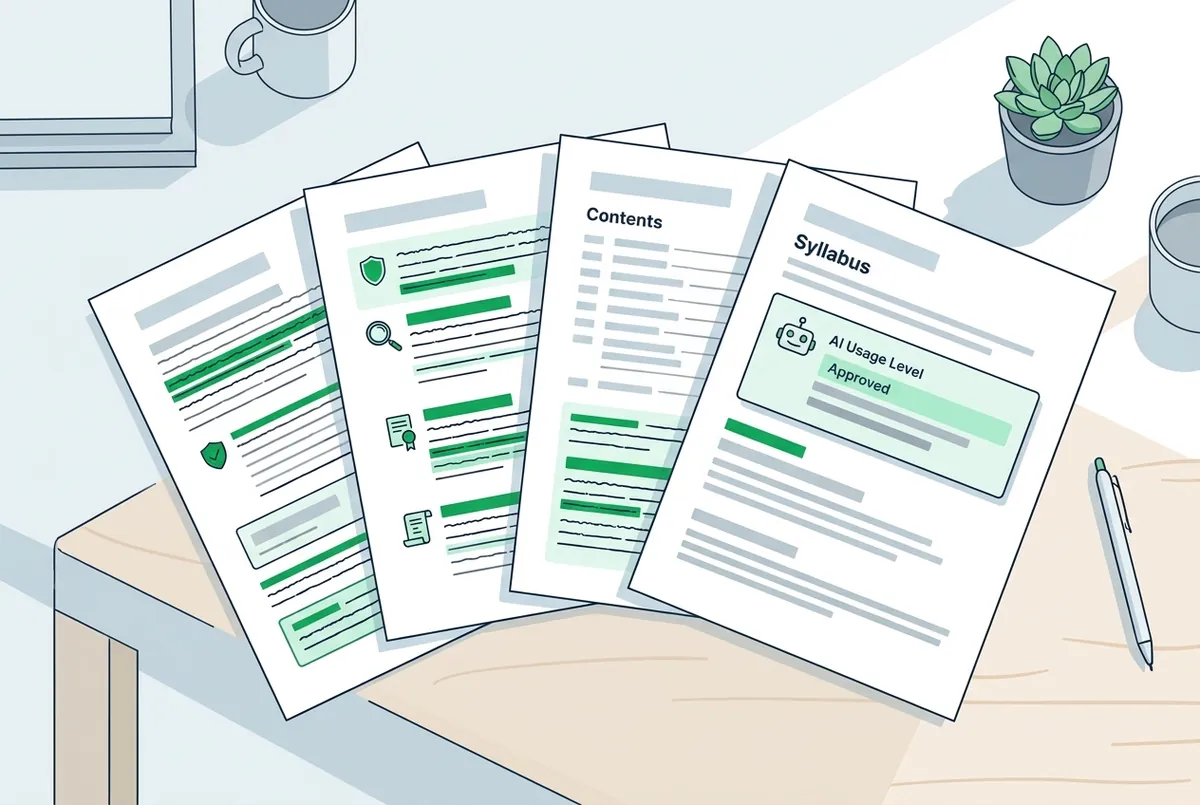
DLSU requires every course from Term 1, 2025-2026 to state its AI usage level in a dedicated syllabus section. The policy is blunt about detectors: 'even high percentage outputs are not a definitive indication of cheating.'
Using AI on a thesis or capstone project
Thesis and capstone work faces the strictest disclosure rules in Philippine universities. Ateneo requires researchers to disclose intended GenAI use before starting, to capstone, thesis and dissertation advisers, and to name the exact tools, models and versions where possible.
At the end of the project, Ateneo expects the actual use of GenAI to be spelled out in the output, and it states that AI systems are neither authors nor co-authors. FEU asks thesis and dissertation writers to list each GenAI tool and its use in the References section. UP Diliman's IESM tells faculty to set boundaries for AI-generated content in theses, dissertations and publications.
- Agree on permitted AI use with your adviser in writing before data collection or drafting begins.
- Keep a log of every tool, version, prompt and output you rely on.
- Verify every fact, citation and figure an AI tool produces against a reliable source.
- Never enter research data into an outside AI tool without security measures such as anonymization, as Ateneo requires.
- Write your disclosure statement as you go, naming each tool and how much it shaped the final text.
- Bring your drafts and notes to the defense so you can explain every chapter in your own words.
If your adviser permits editing help, the Walter Writes AI humanizer in Academic mode belongs in that disclosure like any other tool. For rules in other countries, see our guide to using Walter Writes AI outside the US.
Philippine English: which spelling to use
Use American spelling for most Philippine university work. A 2019 corpus study in the Asian EFL Journal found that, among the outer circle Asian Englishes it analyzed, only Philippine English has American English as its parent variety.
In practice, that means color, organize and center, applied consistently. Mixing in British forms after editing with a tool set to UK English is a common slip, so set your spellchecker to English (United States) and follow the citation style your adviser names. Ateneo's guidelines point to APA guidance for citing ChatGPT.
What happens if your paper is flagged for AI
A flag starts a review that needs more than a detector score at the universities above. DLSU lets faculty file a case only when a suspicious submission comes with other evidence of non-ownership, such as failing to answer questions consistently with the work, failing to explain your thought process, or failing to show the same skills in a controlled setting.
The stakes at DLSU are high. Its policy treats AI-related dishonesty as cheating, a major and non-mediatable offense, and a student found guilty is disqualified from graduating with honors. The LaSallian reports that the student Legislative Assembly contributed Section 7.2, which sets out the appeals process.
At UP Diliman IESM, suspected cases go first to a respectful academic conversation, and misconduct is handled under the 2012 Code of Student Conduct. IESM advises students to stay calm and be ready to explain their process.